
Hello again! As promised, even if a little delayed, are some pictures of my front garden, It certainly has been a work in progress, in fact it still is and always will be I guess.


I absolutely love it and am proud to have created this on my own (with a little help from mum and dad x) As you can see, Muffin quite likes it too!
I have managed to remain mostly true to the original concept which I drew up months ago, however the original design when I first moved in was going to be a formal cottage garden.( I showed a sketch in an older post).
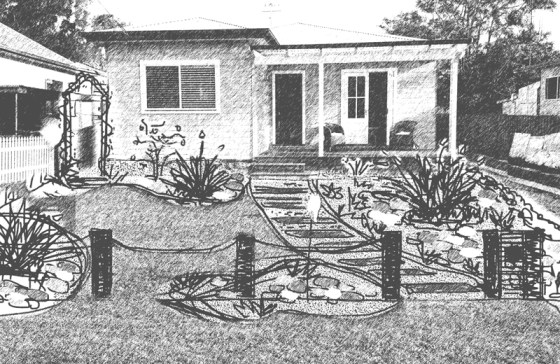
I then changed my mind wanting a more free, beach style cottage garden. I can’t help myself but to include some formality in my designs. No matter how hard I try, I never seem to end up with a carefree, loose design (probably for that very reason – I ‘try’ instead of letting it flow). I changed my mind about the rope fence and decided to use more of the Jetty timbers, so the garden now has some Long Jetty history, giving it more sentimental value and quirky, unique character. I am planning to make my own letterbox and have the design ready to go. Once the letter box is complete I will have a plaque of some kind on the front saying where the timbers and the plants in the garden came from.
Something like –
In the Heart of the Garden – “the timbers used in this garden have been recycled from the old Salt Water Creek Pedestrian Bridge and Watkins Jetty with most of the plants gifted from my kind friends”


Also just wanted to say a very special thank you to the following friends for your kind offerings –
My sister Michelle – for the largest Agaves, Mum for striking the jasmine and buying the Jacaranda Tree (and dad for helping me concrete the timber), Melissa – Agaves and succulents, Lisa & Derani for the Red Fountain features, Robyn the Sun Parasol, Jenny for the Rhoeos and a variety of smaller succulents (and your gardening advice!), Rhonda for more succulents and the beautiful Date Palm which has now been planted into its own pot, my neighbours Jacko and Carina for the Frangipanis, Bruce the butcher for more Frangipanis, Peter for the Camellia (planted at the side), and Sue for the Lemon Grass. The rest came from Bunnings!
I thought for all the garden lovers I would put a brief description of all the plants used. The garden faces north and is in direct sun all day so I have selected only the plants that I thought could tolerate these conditions. The soil is pretty sandy here so I had some good quality garden soil delivered and built up the beds before planting. I also used river rock in two sizes 40mm and large rock delivered from Tumbi Soil and Sand.
Here is a list of the plants living in my garden.
- AGAVE ATTENUATA – A bold, architectural succulent occuring naturally in southern USA and Mexico. The plants are perennial, but each rosette flowers once and then dies. Agave’s can be used as feature plants in pots, are great in courtyards and larger landscapes. They are particularly popular in modern garden designs. I have used several Agave’s of different sizes to add sculpture and form in my garden.
- RHAPHIOLEPIS INDICA – Indian hawthorn is a low to mid growing shrub with mid-green, slightly serrated leathery leaves. The species is native to an area from southern China, Japan, Laos, Cambodia, Thailand and Vietnam. The five-petalled flowers are sweetly perfumed. Blue-black berries appear on the shrub after flowering. For best flower colour or for a compact plant, look for named varieties such as ‘Ballerina’. I have used 5 of these across the front of the deck to eventually form a hedge.
- TRACHELOSPERMUM – Commonly known as Star Jasmine, these versatile plants can be used in a variety of ways as climbers, as a groundcover, spreading bushes, or indoor plants. They feature attractive, glossy, oval leaves and as the common name suggests fragrant, white, starry, jasmine-like flowers, in summer. I am using them as a ground cover circling the Red Fountain feature in the centre of the main garden, and also on as a ground cover in form of the picket fence.
- GAURA – also known as Butterfly Bush, is a pretty, water-wise plant, with a succession of flowers over many months. It is a perennial to around 80cm high and wide, which loves the sun, good drainage and a good cutting back as the long wands of butterfly flowers finish. Butterfly Bush is self seeding and will flower again in 6 weeks after pruning. I have used two varieties, white and pink.
- PLUMERIA – common name Frangipani, is a small genus of 7-8 species native to tropical and subtropical Americas. The genus consists of mainly deciduous shrubs and trees. Plumeria has spread to all tropical areas of the world, especially Hawaii, where it grows so abundantly that many people think that it is indigenous there. Frangipani flowers appear in clusters, also at the end of the branches, and are distinctively scented. The petals are waxy with the centre of the flower a different colour to the rest. I have used the most common frangipani has white flowers with a yellow centre. Flowers will appear from December to April in Australia, and even longer in warmer climates. two Frangipani trees feature in my front garden.
- SUCCULENT PLANTS – are plants having some parts that are more than normally thickened and fleshy, usually to retain water in arid climates or soil conditions. They thrive with minimum fuss, flourish with little care and grow in small amounts of soil and the maximum amount of sunshine. Better still they require little moisture, making them a stylish solution to Australia’s water crisis. Succulents have bold foliage forms and bright colours, and their ease of growing has ensured the revival of their popularity. I have used a variety of succulents.
- GARDENIA – is a genus of flowering plants in the coffee family, Rubiaceae, native to the tropical and subtropical regions of Africa, southern Asia, Australasia and Oceania. Attractive evergreen small to medium shrub (1-2m tall and maybe as wide) with deep green foliage. Fragrant and beautiful creamy white flowers which are seen from late spring to late autumn with the main flush in the months leading up to Christmas. Attractive evergreen small to medium shrub (1-2m or 3-6′ tall and maybe as wide) with deep green foliage. A versatile shrub which can be grown as a hedge or a standard, however in my garden I have planted a group.
- SALVIA – Blue and White mixed – This hardy perennial is generally grown as a half hardy annual as it is ideally suited to bedding schemes and containers. Neat bushy plants produce long lasting nectar-laden flowers which are loved by bees. The vibrant purple and white flowers add a striking contrast of colour to the garden.
- PENNISETUM SETACEUM ‘PURPUREUM’ – Red Fountain Grass – This is a spectalcular perennial grass and I am using it as feature plants in the garden. The red foliage and tall arching flower stalks offer strong contrast to other plants in the garden. I will need to cut back old clumps with browning foliage in late winter to insure fresh foliage over the entire clump in spring. This plant does not tolerate wet, cold soils very well.
- RHOEO SPATHACEA – Rhoeo is a short-stemmed tender foliage plant which makes attractive small, dense, clumping rosettes. It forms a solid groundcover of upright purple and green leaves. The unusual flowers, borne down among the leaves, appear as clusters of tiny white flowers nestled within two boat-shaped, purplish bracts. They are not noticeable unless you look closely. I fear that my plants are suffering from getting too wet with poor drainage where I have planted them. Must keep an eye on them.
- ALTERNANTHERA – Little Ruby is the perfect mounding ground cover with a compact, spreading habit and deep burgundy foliage, making it a real stand out plant in the garden. It is approximately a third the height of the common form. This Alternanthera loves humidity, but can also tolerate frost better than most forms. In very cold climates, it will still need to be in a sheltered position. I adore the colour of this plant and it really does make an impact.
- TRACHELOSPERMUM JASMINOIDES TRICOLOUR – Variegated Jasmine – A beautiful climbing or ground covering plant that has small fragrant pinkish-white flowers and with new growth that emerges hot pink and turns to white splashed on green. The flowers actually look like the leaves of the plant. I have used this plant as a hedge and eventually the hedge will continue down the entire driveway.
- MANDEVILLA HYBRID – Giant White Sun Parasol is a climber by nature and produce lots of flowers due to the plants strong branching habit. Pretty varieties require trellis or another structure, such as a fence or pergola for support. I plan to either build or buy a garden arch to support this gorgeous plant, however in the meantime it is staked and able to establish itself until I find what I’m looking for.
Let me know what you think by following my blog and commenting!
I will keep you posted….


 whispers from the jetty